
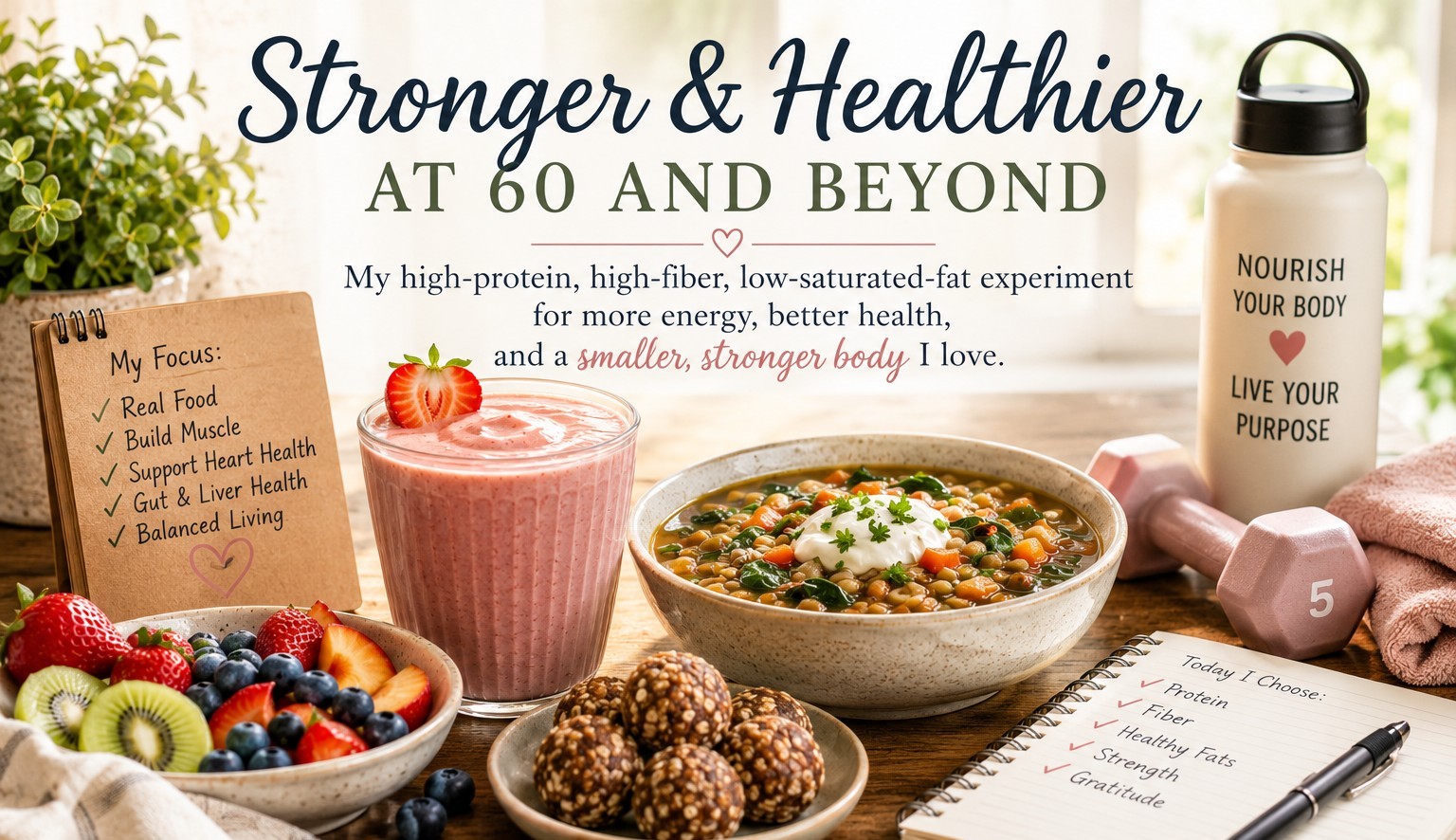
What I’m Doing Differently at 60: My High-Protein, High-Fiber, Low-Saturated-Fat Experiment
Turning 60 has caused me to rethink some things about the way I eat and exercise. For most of my adult life, if I gained a few pounds, I knew what to do. Exercise more. Eat a little less. Get moving.
Then menopause apparently decided those rules were negotiable.
I began putting weight on in places I never had before—especially around my waist. I tried my usual go-to strategies, but the scale simply wasn’t budging.
Then my cholesterol numbers came back higher than I wanted them to be.
I really didn’t want to go immediately to a statin without first seeing what I could accomplish through changes in my diet, exercise and lifestyle. So I started researching what changes after menopause and why some of the things that worked for me when I was younger weren’t necessarily working the same way now.
And that led to an experiment.
Menopause Changed the Equation
The more I read, the more I realized that weight management after menopause isn’t simply a matter of “eat less and exercise more.”
There are several things happening at once.
Estrogen declines dramatically. Body composition tends to change. Women are more prone to losing muscle as we age, while fat is more likely to accumulate around the abdomen. Insulin sensitivity and metabolic health can change as well.
And then there’s stress.
When we’re already dealing with a stressed nervous system, I’m not convinced that piling on more deprivation and exhausting exercise is necessarily the answer.
I didn’t want to spend my days hungry while trying to survive on tiny portions of food. I didn’t want an eating plan that made me miserable for three weeks and then sent me searching the pantry for everything I’d denied myself.
I wanted to feed my body well while eating fewer calories naturally because I was actually satisfied.
That distinction has become very important to me.
My New Trifecta: Protein, Fiber and Low Saturated Fat
Instead of concentrating primarily on calories, I’ve been building my meals around three things:
High protein. High fiber. Low saturated fat.
I’m still paying attention to calories, but they aren’t the centerpiece of every food decision.
Protein helps me build and preserve muscle and makes meals more satisfying.
Fiber fills me up, supports digestive and gut health, and is an important part of the heart-healthy eating pattern I’m using as I work on my cholesterol.
And because lowering my cholesterol is one of the major goals of this experiment, I’m deliberately keeping saturated fat low.
This has completely changed the question I ask when deciding what to eat.
Instead of:
“How little can I eat?”
I’m asking:
“How much nutrition, protein and fiber can I pack into something delicious without loading it with saturated fat?”
That’s a much more enjoyable challenge!
I’m Not Starving—and That’s the Amazing Part
I’ve been eating this way for about two weeks as I write this.
My calories generally fall somewhere around 1,400–1,600 calories per day, even though I’m active working around our property and have begun doing more strength training.
Yet I’m not walking around hungry.
That’s probably the thing that has surprised me most.
The scale has finally begun moving consistently. My stomach already looks a little thinner and less bloated.
But what I’m enjoying most is the energy.
I’ve recently started getting up at 5:00 a.m. to teach early-morning Bible classes for local youth. Last year, getting up that early left me exhausted.
This year, even with the early mornings, property work and exercise, I have been amazed at how much energy I have.
It’s far too early to declare my experiment a success, but I certainly like the direction it’s going.
Muscle Has Become a Priority
One of the biggest changes I’m making isn’t actually in the kitchen. It’s strength training.
Muscle becomes increasingly important as we age, and menopause-related hormonal changes can make preserving lean muscle more challenging.
So rather than concentrating on doing longer and longer cardio workouts, I’m putting more emphasis on building strength—particularly in my arms and legs.
As my conditioning improves, I plan to incorporate more short, higher-intensity workouts along with my regular activity.
I’m no longer exercising simply to “burn calories.”
I’m exercising to build a stronger 60-year-old body.
That’s a very different goal.
I’m Also Experimenting With Nutritional Support
I’m using several supplements as part of this personal experiment, particularly products aimed at menopause, cardiovascular health, cholesterol, omega-3 intake, gut health and metabolic support.
At the moment, those include:
- EstrAval® Menopause Support
- Phytomega® Cholesterol Support
- CardiOmega EPA™
- AKKA Akkermansia Probiotic
The first three are products I purchase through Melaleuca, and I purchase AKKA through Amazon.
I’m deliberately calling these support, rather than saying they’re treating anything. Supplements are one piece of what I’m doing; they aren’t a substitute for the changes I’m making in the foods I eat, my activity level, sleep, stress management or medical care.
I’m particularly interested in emerging research around the gut microbiome and organisms such as Akkermansia muciniphila, as well as nutrients and plant compounds associated with metabolic and cardiovascular health.
I’ll be interested to see what my future bloodwork shows.
Disclosure: I have a relationship with Melaleuca and can help someone become a customer if they’re interested in the products I use. I’m sharing these because they’re part of my own routine—not because I’m suggesting everyone needs the same supplements.
What Does This Look Like in My Kitchen?
This is where I’ve been having fun.
I don’t want “diet food.”
I want food that is quick, easy, delicious and satisfying—and happens to help me reach my nutritional goals.
So I’ve been inventing recipes.
I keep nonfat Greek yogurt in the refrigerator almost all the time. I keep quick oats, Medjool dates, pecans and cocoa in the pantry.
And then there is fruit.
Lots of fruit.
Apples, peaches, blueberries, strawberries and golden kiwi have become regulars around here.
One of my favorite tricks is pulsing together some combination of Medjool dates, pecans and oats, then adding either cinnamon or cocoa and a little vanilla.
Sprinkled over sliced apples or peaches—or a bowl of blueberries and strawberries—it feels like dessert.
But instead of eating something that leaves me hungry again an hour later, I’m getting fruit, fiber, whole grains and nuts.
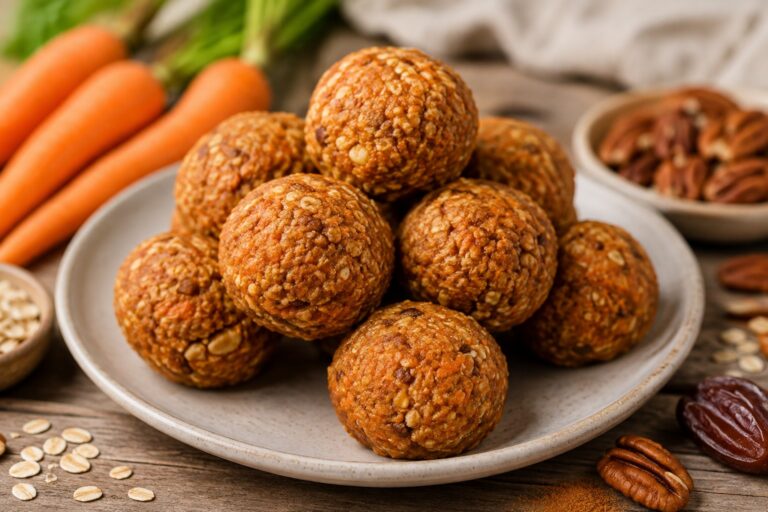
I’ve also been making my Carrot Pecan Energy Bites to keep around when I want something sweet and satisfying.
And I’m developing actual meals around the same philosophy.
My Strawberry Greek Yogurt Smoothie
One of my easiest discoveries has been my Strawberry Greek Yogurt Smoothie.
It takes only a few minutes in the Vitamix and combines strawberries, nonfat Greek yogurt, lemon juice and vanilla into something that tastes like a treat while giving me a nice serving of protein without much saturated fat.
→ Get the Strawberry Greek Yogurt Smoothie recipe
My Lentil-Barley Vegetable Soup
Then there’s my Lentil-Barley Vegetable Soup.
This one is loaded with lentils, barley and vegetables, and I often add a dollop of nonfat Greek yogurt to my bowl for extra creaminess and protein.
It’s hearty enough that I don’t finish eating and immediately start wondering what else I can have.
→ Get the Lentil-Barley Vegetable Soup recipe
This Isn’t a Diet. It’s an Experiment in Nourishing Myself Better.
I’m only two weeks into this, so I’m not writing a dramatic before-and-after story. I don’t know yet what my cholesterol numbers will look like. I don’t know exactly how much weight I’ll ultimately release.
And I fully expect to adjust things as I learn more and discover what my body responds to.
But something has already shifted in the way I think about food. I’m not trying to see how little I can eat. I’m trying to figure out how well I can feed myself.
- Can I give my body plenty of protein?
- Can I get plenty of fiber?
- Can I dramatically reduce the saturated fat in my diet without sacrificing flavor?
- Can I build muscle instead of simply trying to make myself smaller?
- Can I create meals and snacks that make a calorie deficit happen without spending the day hungry?
- And can I improve my cholesterol and metabolic health in the process?
- Those are the questions behind this experiment.
So far, I’m releasing weight. My waistline is beginning to change. I’m not hungry. I have energy. My body isn’t aching as much as it used to.
And perhaps best of all, I’m enjoying what I’m eating.
That’s enough encouragement for me to keep going.
I’ll keep sharing the recipes I create along the way—and I’ll report back on what happens with my weight, measurements, energy and, eventually, my next round of bloodwork.
Here’s to getting stronger—not just smaller—after 60.