
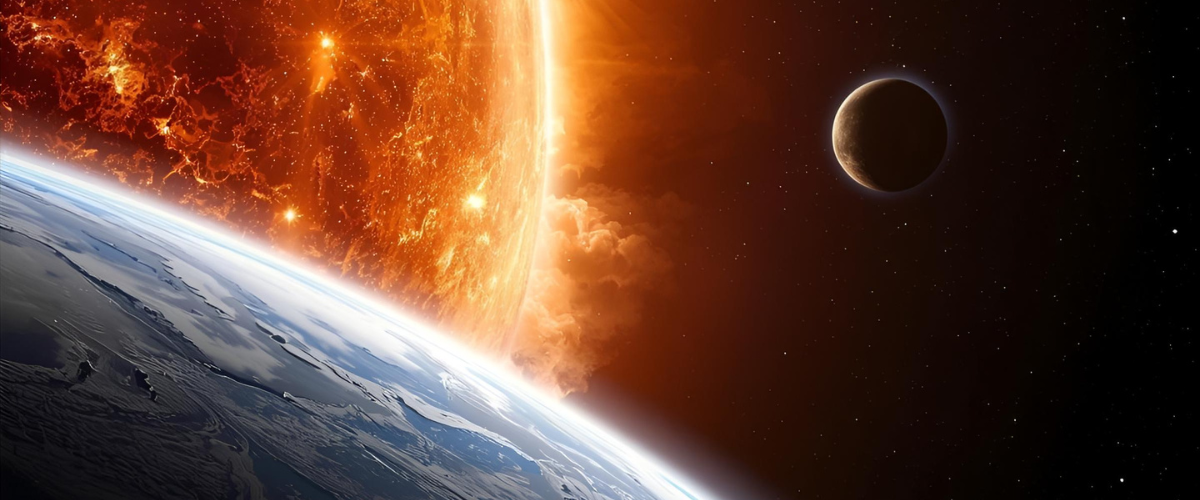
Tracking Space Weather and Its Impacts on Earth
I’ve been keeping up with space weather lately and find it completely fascinating. I particularly enjoy geophysicist Stefan Burns’ YouTube channel. While I don’t always understand everything he says, he’s teaching me a lot!
I’m especially intrigued by his explanations of how sunspots, solar flares, coronal holes, and coronal mass ejections (CMEs) send energetic plasma waves toward Earth that can influence our planet’s magnetic field. He tracks correlations between these solar phenomena and earthquakes and volcanic activity.
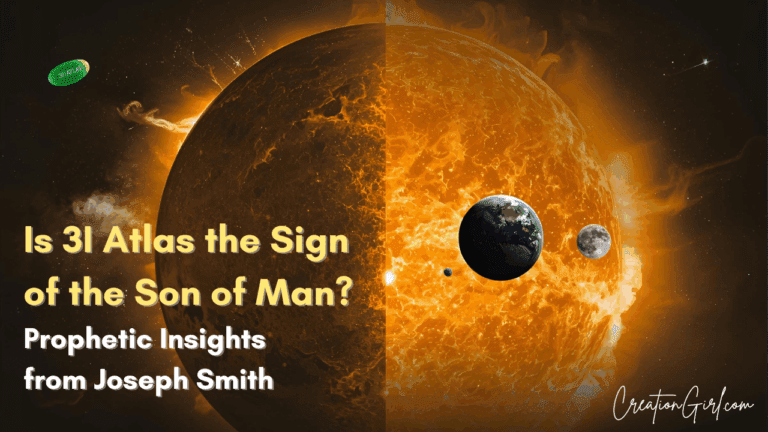
He also notes connections between intense solar activity and planetary geometry—when planets align, for example—as well as the presence and location of comets and interstellar objects. For instance, when interstellar object 3I/ATLAS approached the Sun, the Sun unleashed a series of intense solar flares that pummeled the object. Fortunately, 3I/ATLAS was on the opposite side of the Sun from Earth, so those flares didn’t directly impact us.
As of the first week of November 2025, the large coronal hole that had been spewing plasma toward 3I/ATLAS is rotating toward Earth. The activity from that hole hasn’t let up, so it will be interesting to see how much impact it has on Earth as it faces us again. The Sun rotates roughly every 27–28 days, and each time that coronal hole turns our way, it tends to send out high-speed solar wind streams. When those streams are strong enough, earthquakes of magnitude 6.0 or higher have followed, and some volcanoes have rumbled or erupted shortly afterward.
For example, on November 2–3, solar activity increased sharply from C3.7 to M5.0 class flares. Around the same time, a 6.3 magnitude earthquake struck Afghanistan in the early hours of November 3, 2025, killing more than a dozen people, injuring hundreds, and damaging some of the country’s most beautiful mosques.
☀️ Keep an Eye on Space Weather
Here are a few reliable sites for monitoring current solar and geomagnetic conditions:
- SpaceWeatherLive.com – Solar Activity
- NOAA SWPC – Space Weather Prediction Center
- NASA’s Solar Dynamics Observatory – Latest Solar Images
- Earth Evolution – Earth Analytics (Stefan Burns’ Web Site)
X-ray Flare Classifications
| Class | Flux Range (1–8 Å) | Typical Description |
|---|---|---|
| A | < 10⁻⁷ W/m² | Very quiet background level |
| B | 10⁻⁷ – 10⁻⁶ W/m² | Small fluctuation |
| C | 10⁻⁶ – 10⁻⁵ W/m² | Minor flare, common during active periods |
| M | 10⁻⁵ – 10⁻⁴ W/m² | Moderate flare; can cause minor radio blackouts (R1–R2) |
| X | ≥ 10⁻⁴ W/m² | Major flare; possible radiation storms, strong CMEs, radio blackouts (R3–R5) |
⚡ Monitoring Radiation (Proton Flux) from CMEs
GOES Proton Flux measures the number of high-energy protons (charged particles) reaching Earth, as detected by NOAA’s GOES satellites in geostationary orbit. It shows how intense a solar radiation event is, especially after large flares or CMEs.
A sudden rise in proton flux following a flare indicates that the Sun has ejected energetic particles, which can affect satellites, radio communications, and radiation exposure.
High proton flux can:
- Pose radiation risks to astronauts and high-altitude flights (especially near the poles)
- Disrupt satellites and communications
- Sometimes precede or accompany geomagnetic storms
🧭 NOAA Radiation Storm Scale (S-Scale)
| S-Level | >10 MeV Flux (pfu) | Description |
|---|---|---|
| S1 | ≥10 | Minor |
| S2 | ≥100 | Moderate |
| S3 | ≥1,000 | Strong |
| S4 | ≥10,000 | Severe |
| S5 | ≥100,000 | Extreme |
🌍 Why Proton Flux Matters
When the Sun releases a powerful flare or CME, it can accelerate protons to near-relativistic speeds. If those protons are directed toward Earth, they can arrive in minutes to hours—long before the bulk of the CME plasma, which typically takes 1–3 days.
That’s why GOES Proton Flux graphs are one of the first early-warning indicators of radiation storms.
🌎 Geomagnetic Storms (Kp and G-Scale)
Once the solar particles actually reach Earth, their interaction with our planet’s magnetic field can trigger geomagnetic storms—measured by the Kp index and NOAA’s G-scale.
When the charged particles from a coronal mass ejection (CME) or high-speed solar wind stream reach Earth, they interact with our planet’s magnetic field. The disturbance is measured by the Kp index, which runs from 0 (quiet) to 9 (extreme).
NOAA converts Kp values into the G-scale—a simple way to classify geomagnetic storm intensity and potential effects. Click here to see NOAA’s Planetary K Index Chart (Kp).
| Kp Index | G-Scale | Category | Typical Effects |
|---|---|---|---|
| 0–3 | — | Quiet | Normal geomagnetic conditions |
| 4 | — | Active | Mild disturbances, aurora near polar regions |
| 5 | G1 | Minor Storm | Weak power grid fluctuations; aurora visible at high latitudes |
| 6 | G2 | Moderate Storm | Possible voltage alarms, aurora visible as far south as New York or Idaho |
| 7 | G3 | Strong Storm | Intermittent GPS issues; aurora visible to mid-latitudes |
| 8 | G4 | Severe Storm | Widespread power fluctuations, degraded HF radio and satellite operations |
| 9 | G5 | Extreme Storm | Possible grid damage, spacecraft anomalies, aurora visible in southern U.S. |
The higher the Kp number, the more turbulent Earth’s magnetic field becomes—and the more spectacular the auroras!
🪐 Planetary Geometry
Another factor that seems to play a role in the intensity of solar flares—and their impact on Earth—is planetary geometry. When planets align, or when the Moon, comets, or interstellar objects occupy certain positions, the combined gravitational and electromagnetic stresses may influence solar activity and even correlate with increased earthquake, storm, or volcanic events.
You can explore these alignments interactively using TheSkyLive.com, which lets you move through time to visualize the positions, conjunctions, and interactions of planets, comets, and interstellar objects.
🔭 Explore the Signs of the Times
If you’re interested in how space weather might tie into the signs of the times, I invite you to visit and subscribe to my Signs of the Times YouTube channel.
Have you noticed how solar storms seem to affect your energy, mood, or technology? Share your experiences below!