
Forest Therapy Journal: Making Friends with the Trees
I’m currently working toward my Forest Therapy Certification, and one of our first assignments was to spend an hour in nature, moving beyond simply observing the natural world to experiencing ourselves as part of it. We were invited to recognize trees, plants, and other creations as fellow beings rather than objects in our surroundings.
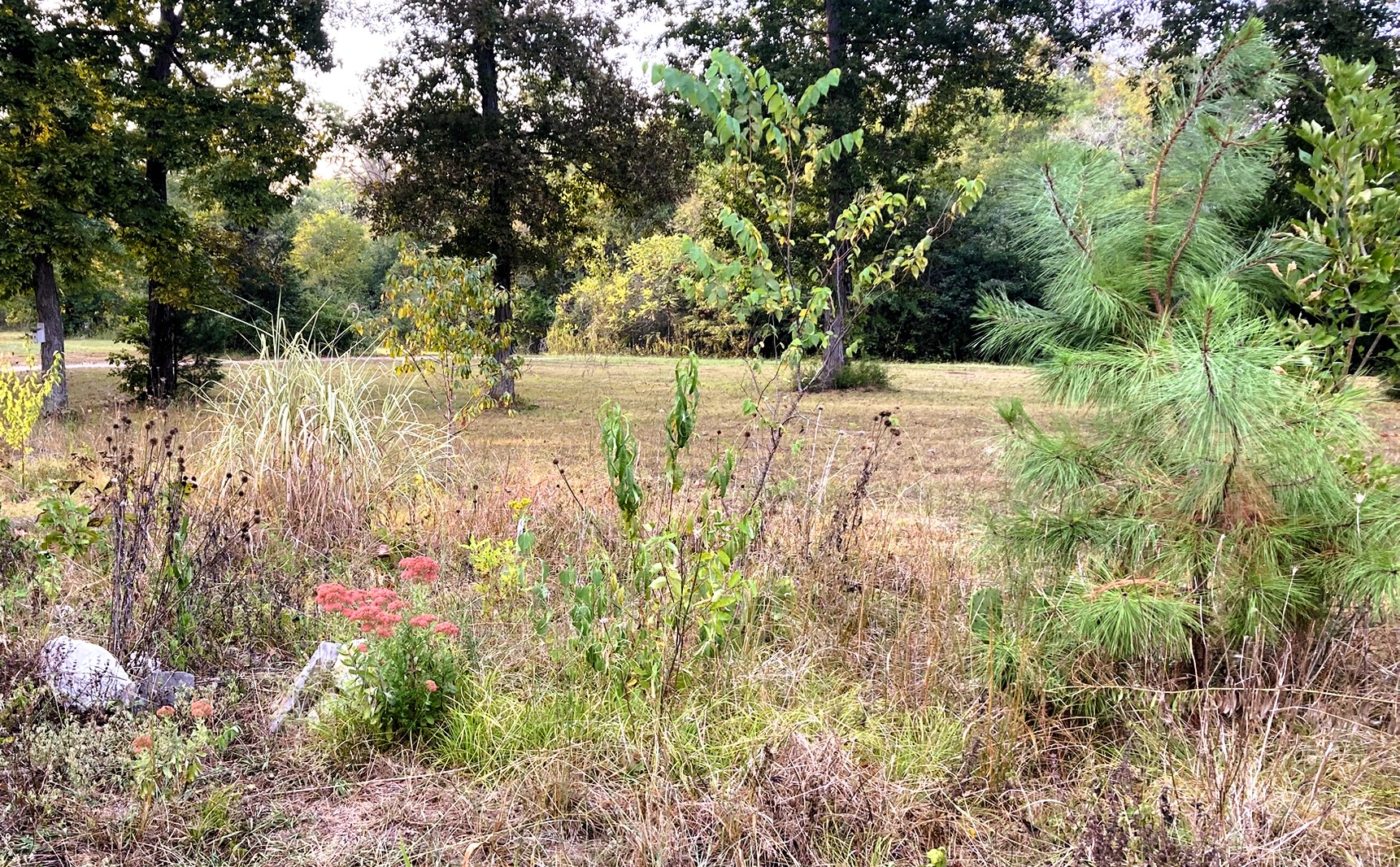
I decided to begin in my own front yard at Spirit Tree Farms. What started as an interview with a loblolly pine became an unexpected encounter with several new friends and some beautiful lessons about life, relationships, adversity, and our Creator.
Here is my first journal entry.
Entry #1 — Saturday, September 19, 2026, Spirit Tree Farms, Northwest Georgia
Assignment: Sit in nature for an hour until you experience a feeling of oneness with it. Rather than simply observing nature, recognize yourself as part of it. See the trees, plants, and other creations as fellow non-human beings.
Today, I decided to interview the loblolly pine in our front yard.
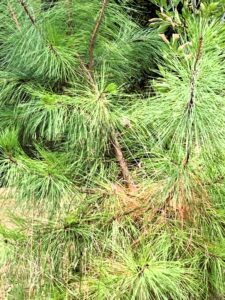
Its long needles remind me of those fun fiber-optic lamps at Spencer Gifts, with light shooting out the ends of them.
The needles are long, soothing, tactilely pleasant. Fun, even. They splay out joyfully. Kind of like porcupine quills, but not poky like that. More like a bushy dog whose hair stands on end.
Bold, audacious needles.
Out there, doing their own thing, being their unique selves.
The bark is probably a bit “sappy,” sticky from pine resin.
Next to the loblolly grows some Eastern prickly pear.
Interestingly, the prickly pear is covered with fine, hair-like spines that are deceptive. They’re barely visible but horribly painful to touch. These tiny spines grow alongside the larger, more obvious spikes spaced across the pads.
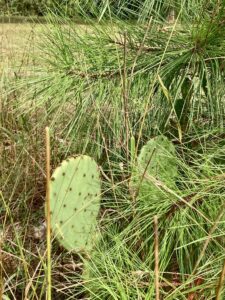
Prickly pear also produces a red fruit you can make jelly from.
It’s growing very close to the loblolly pine, almost underneath it.
The loblolly isn’t nearly as poky as many other pines and is far less dangerous to touch than the prickly pear.
Interestingly, these two creations grow as companions.
The loblolly is brazenly “out there” with what it is, while the prickly pear is more deceptive. Somewhat forthcoming with its larger spikes, but deceptive nonetheless.
You could easily be tricked into thinking you could pick it up by the green areas between the bigger brown spikes. But you’d be in pain within seconds and have a hard time even seeing the fine, hair-like spines to remove them.
The loblolly is like a benevolent, wild, crazy friend.
The prickly pear is more like someone with hidden landmines. Some dangers you can see, but not all. Not by a long shot.
These two creations are like joy and suffering occupying the same space, cohabitating in the same circumstances.
Suffering often hollows out our crucible’s capacity for joy.
Or perhaps our pleasure-seeking desire to touch the loblolly’s fun, vibrant, floppy needles might cause us to miss the prickly pear underneath and result in pain.
The law of opposition in all things is at work in one little spot of our yard.
The Sedum and the Cedar
I’m most attracted to the deep, dusty salmon color of the sedum flowers growing in clusters a few feet from the pine.
The sedum stems are a couple of feet high. Their beautiful clusters of flowers grow in cloud-like umbrellas composed of hundreds of tiny salmon-colored blossoms.
I can see a light, pale blue aura emitting from the flowers.
Blue is usually associated with the throat chakra, although that’s typically a deeper blue than this pale shade.
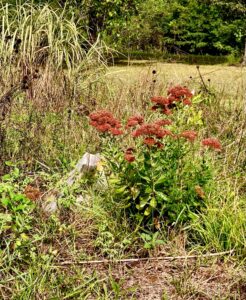
The firm, sturdy flower poms are a deep, burnt orangish-red. Maybe sacral chakra related.
The green leaves are thick, velvety, and succulent. They’re very soothing, and their green could represent the heart chakra.
The entire sedum is a sturdy plant with a feeling of unity about it.
The tiny flowers comprising the poms give them a sort of “strength in numbers” congregational feeling and message.
There’s a tiny Eastern red cedar growing next to the sedum, almost within it.
The cedar isn’t even as tall as the sedum.
It almost looks like the sapling knows the sedum is strong and comforting and is seeking shelter under its nurturing presence until it’s tall enough and strong enough to surpass it.
There’s another sedum plant a couple of feet away that isn’t nearly as big. Perhaps only one-tenth the size of the other.
Its flowers aren’t as vibrant, and the flower poms are smaller, either not fully opened yet or perhaps starting to close up.
The two sedums are fellow beings growing near each other, one perhaps the child of the other.
One is vibrant and providing shelter to the Eastern red cedar. The other is just getting its footing, but blooming and coming into its own.
The Little Peach Tree
There’s a peach sapling growing between the loblolly and the sedum.
Its long, slender leaves look like they could use some moisture.
It’s still alive, but it looks a bit “peaked” (or “pekid,” as my Southern Mama would say) after so many record-breaking days of heat over the last month, with very little rain.
These plants are each like people, with their own personalities, strengths, and ways of dealing with adversity.
The loblolly, overall, is thriving. There is one small bunch of needles that are brown and dying, but the rest of the tree looks healthy.
They’re all growing in a poor spot of soil. Rocky, barely any soil at all, really. A limestone shelf.
Yet each seems to have found a way to thrive against the odds.
I see so much to admire:
Strength. Ingenuity. Companionship. Camaraderie. Nurturing. Cooperation. Strength and unity in numbers. Resilience. Resourcefulness.
Thriving against the odds and in poor circumstances.
What My New Friends Are Teaching Me
Maybe, sitting here with them, they’d be willing to bequeath me some of their virtues.
Their ability to exude joy, stand firm, be themselves, and yet willingly embrace and coexist with beings much different from themselves.
Or even those who are similar but handle life differently, like the loblolly and the prickly pear.
The willingness to give shelter, comfort, and strength to someone who will one day far surpass you in reach, height, and influence, like the sedum and the Eastern red cedar.
Or simply giving life all you’ve got. Your very best try. Like the little peach tree trying to grow on a slab of limestone.
Will its roots even grow deep enough for it to become a tall tree bearing fruit?
Perhaps it will.
Its mother found a way.
She grew massively tall from a random peach pit tossed outside by our deck and now bears fruit in abundance.
Is resourcefulness genetic?
We shall see.
Becoming One with Nature
While I’m an observer of these plants and trees, I am also one with them.
We are fellow beings on this planet.
We all want essentially the same thing: to thrive, be ourselves, reproduce, have a purpose, create connections, build relationships, and make the most of our time on earth.
I feel like I made a few new friends today. Non-human beings I can admire, learn from, and model.
They’re messengers from our Creator, letting their lights shine and His love flow through them unrestrained.
Thank you, Sedum.
Thank you, Loblolly Pine.
Thank you, Eastern Red Cedar.
Thank you, Peach and Prickly Pear.
Love to you all!
And thank you, Heavenly Father, for my new friends and what they teach me about Thee and Thy Son, and about the love and light in every creature and creation.